
For U.S. citizens and green card holders living in Switzerland, Pillar 2 is one of the most significant financial assets they will accumulate over a career. It is also one of the most misunderstood from a U.S. tax perspective.
At the center of that misunderstanding is a concept that receives far too little attention: basis tracking.
If you have been contributing to a Swiss Pensionskasse without tracking your U.S. tax basis, you may be setting yourself up for unnecessary double taxation when you eventually receive a distribution. The good news is that the problem is fixable. The better news is that it is much easier to fix if you start now.
What Is Swiss Pillar 2?
Switzerland's retirement system is built on three pillars designed to work together:
- Pillar 1 is the state pension (AHV/AVS), similar to U.S. Social Security.
- Pillar 2 is the occupational pension (BVG/LPP), funded by both employer and employee contributions through a pension fund known as a Pensionskasse.
- Pillar 3 is voluntary private savings, available in restricted (3a) and flexible (3b) forms.
For most employees in Switzerland, Pillar 2 participation is mandatory once your annual earnings exceed the entry threshold (CHF 22,680 as of 2025-2026). Assets accumulate in your Pensionskasse throughout your working life and are paid out at retirement, upon leaving Switzerland, or in other qualifying circumstances, either as a lump sum, an annuity, or a combination of both.
For Swiss residents, Pillar 2 is simply a pension. For U.S. persons, it is also a foreign financial account with a web of annual reporting obligations and a tax treatment that depends heavily on one critical factor: how much of the account's value has already been taxed by the IRS.
Read more Swiss Pillar 2 Overview | Swiss Pillar 1 | Swiss Pillar 3
Understanding Tax Basis in a Retirement Account
In U.S. tax terminology, basis (sometimes called cost basis) in a retirement account refers to the after-tax dollars that have already been subject to U.S. income tax. When you eventually receive a distribution, the IRS only taxes the portion that exceeds your basis, meaning the growth and any contributions that were not previously taxed.
If you fail to track basis, the IRS has no record of your prior tax payments, and the entire distribution may be treated as ordinary taxable income. Contributions taxed in the year they were made become taxable a second time. Over a long career, this can represent tens or hundreds of thousands of dollars in avoidable tax.
In the U.S. domestic context, the IRS provides Form 8606 to track non-deductible IRA contributions. The Pillar 2 equivalent is considerably more complex, because the account was never designed with the U.S. tax system in mind.
Why Pillar 2 Creates a Basis Problem for U.S. Expats
The core issue is a fundamental conflict between how Switzerland and the United States each tax Pillar 2.
Two Tax Systems, Opposite Timing
The table below summarizes how the two systems treat the same Pillar 2 account:
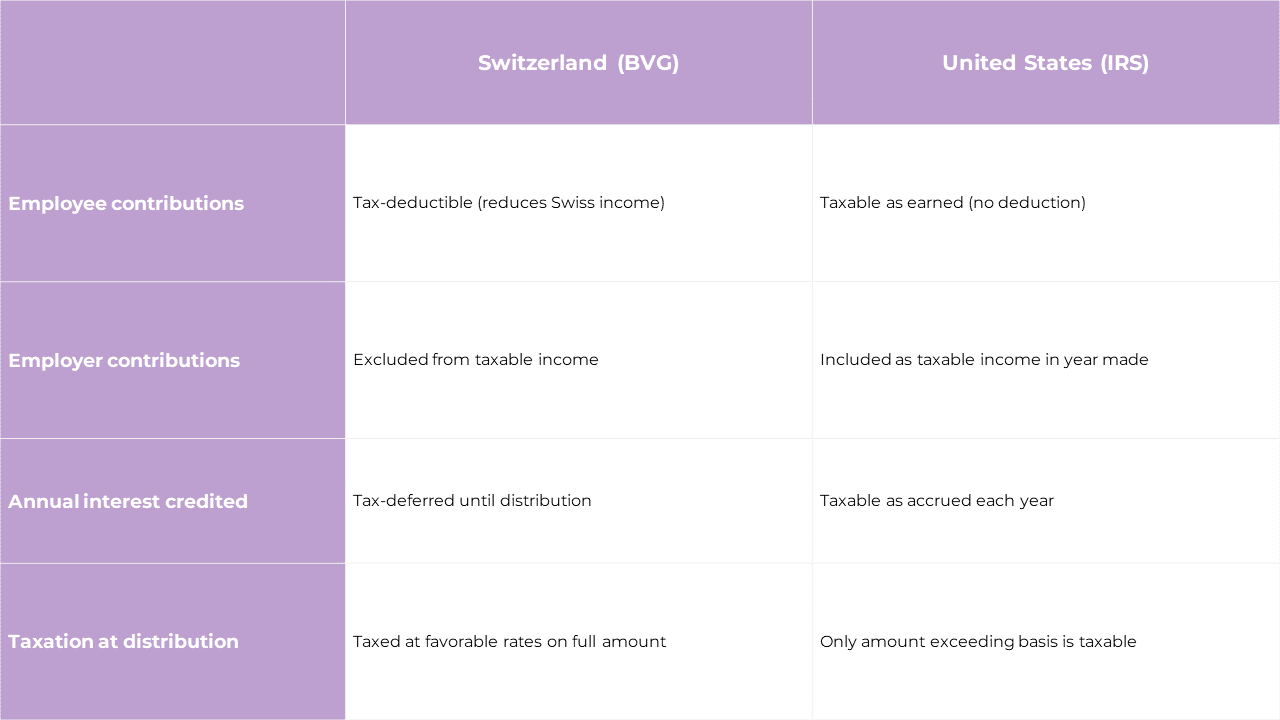
Switzerland taxes Pillar 2 money once, at the back end, upon distribution. The U.S. taxes it as it comes in, year by year. Because the U.S.-Swiss Tax Treaty does not recognize Pillar 2 as a qualified retirement plan, there is no treaty provision that aligns the timing of these two systems.
The result is a timing mismatch that creates a genuine double-taxation risk. A U.S. person contributing to Pillar 2 is paying U.S. tax on income that has not yet been touched by Swiss tax. When distribution eventually arrives, Switzerland taxes the full payout, while the U.S. should only tax the amount that has not already been subject to U.S. tax. The operative word is "should." Without careful records proving what has already been taxed in the U.S., the IRS has no basis for giving you that credit.
Whatever has already been included in your U.S. gross income creates basis. Contributions taxed when made, and interest taxed as it accrued, should not be taxed again at distribution. Without records, you cannot prove this to the IRS.
The Real Cost of Not Tracking Basis
Failure to maintain accurate basis records creates several distinct risks:
Double Taxation at Distribution
If you receive a lump-sum payout from your Pensionskasse at retirement or when leaving Switzerland and you cannot demonstrate your basis, the IRS may treat the entire amount as ordinary income. Over a 30-year career, the cumulative contributions and interest that were already taxed could easily reach six figures. Paying tax on that amount a second time is a significant and avoidable cost.
Complications at Job Changes and Employer Transfers
When changing employers in Switzerland, Pillar 2 assets are typically transferred to a Freizugigkeitskonto (vested benefits account). While this is not a distribution under Swiss law, the IRS may treat the entire account as subject to U.S. taxation at the point of transfer. Understanding your basis in the account at that moment is essential to calculating any U.S. tax exposure correctly.
Lump-Sum Withdrawal When Leaving Switzerland
U.S. persons who leave Switzerland permanently and withdraw their Pillar 2 as a lump sum face a potentially large taxable event. Swiss withholding tax applies at a reduced rate (partially reclaimable under the treaty), while the U.S. taxes the distribution as ordinary income to the extent it exceeds basis. Without a well-maintained basis record, the taxable amount on the U.S. side will be overstated. With proper basis tracking, this event becomes a planning opportunity rather than a surprise.
Early Withdrawal for Real Estate Purchase
Swiss law permits Pillar 2 withdrawals for the purchase of a primary residence. For U.S. persons, this is a taxable distribution that may also trigger penalties. If you are considering this option, please speak with a cross-border advisor before signing anything or placing a deposit. The Swiss advantage disappears quickly once the U.S. tax implications are factored in.
Death and Survivor Benefits
Pillar 2 benefits paid to a surviving spouse or dependents may carry their own U.S. tax treatment. Basis in the decedent's account is relevant to determining the taxable portion of any lump-sum death benefit, making accurate records important for estate planning as well as retirement planning.
What Good Pillar 2 Basis Tracking Looks Like
Tracking your Pillar 2 basis is not a one-time task. It is an annual discipline that should be maintained throughout your Swiss working life, alongside your regular U.S. tax filing obligations.
Annual Documentation Checklist
Each year, you should retain the following:
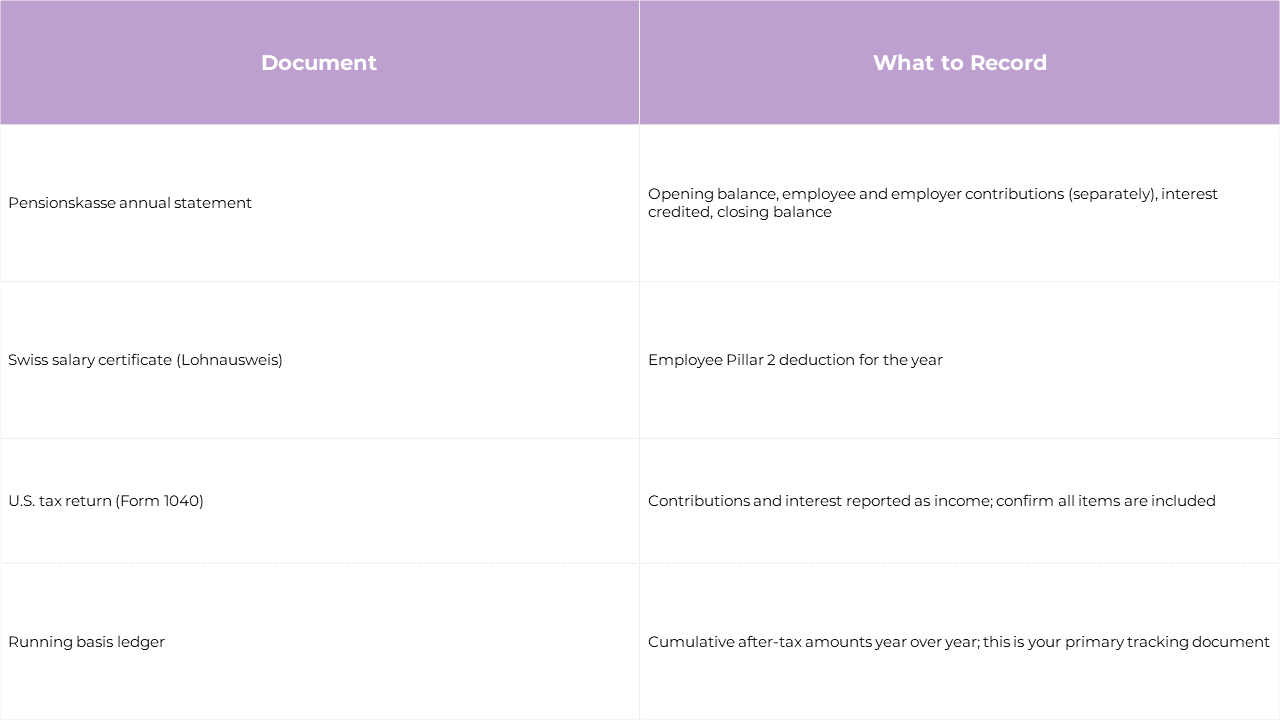
The running basis ledger is the most important of these four. It is the document that accumulates your after-tax investment year over year, and it is the document the IRS would need to see if your return were ever questioned.
Reconstructing Prior Years
Many U.S. persons in Switzerland encounter this issue for the first time when approaching retirement or when they engage a cross-border specialist for the first time. Reconstruction of historical basis is possible, but it requires pulling together tax returns, Pensionskasse statements, and Lohnausweise going back to the beginning of Swiss employment (or the start of U.S. person status, if later).
The earlier this reconstruction work begins, the more complete it can be. Annual statements are not always retained indefinitely by Pensionskassen, and older tax returns may require requests from the IRS or a tax advisor's files.
Key point Pensionskasse statements should never be discarded. You will need them at the time of distribution, potentially decades in the future. Unlike most financial documents, these should be retained permanently.
Pillar 2 and U.S. Reporting Requirements
Beyond basis tracking, Pillar 2 triggers several annual U.S. reporting obligations that are worth understanding together, as they reinforce why careful record-keeping matters:
- FBAR (FinCEN Form 114): Required if the aggregate value of your foreign financial accounts exceeds $10,000 at any point during the calendar year. Pillar 2 is generally considered a foreign financial account for FBAR purposes.
- FATCA (Form 8938): Required if your total foreign financial assets exceed applicable reporting thresholds. Pillar 2 is typically included.
- Foreign Trust Reporting (Form 3520/3520-A): Whether Pillar 2 constitutes a foreign trust for U.S. tax purposes is a nuanced question that depends on the structure of the specific Pensionskasse. This is one of the many reasons why working with a specialist is so important.
Each of these obligations is separate from basis tracking, but they are interconnected. The same annual Pensionskasse statements you need for basis documentation are also the source records for FBAR and FATCA reporting.
Note U.S. tax law and reporting thresholds change over time. The obligations described above reflect general principles, not guaranteed current requirements. Always confirm with a qualified cross-border tax advisor.
Practical Steps to Get Started
- Start a basis tracker today. Even if you have been in Switzerland for years without tracking basis, begin now. Reconstruct prior years as completely as possible, document your methodology, and build the annual habit going forward.
- Gather your Pensionskasse statements. Contact your pension fund for historical statements if you do not have them. Many funds can provide statements going back several years on request.
- Cross-reference with your U.S. tax returns. Your prior-year Form 1040s (and any amended returns) should reflect the Pillar 2 contributions and interest that were reported as income. If they do not, that is a separate issue worth addressing with a specialist.
- Work with a U.S. tax advisor who specializes in U.S. expats in Switzerland. The intersection of Swiss pension law and U.S. tax treaty provisions is narrow, technical, and consequential. A generalist may be a fine practitioner in many respects, but this is not an area where general knowledge is sufficient.
- Do not wait until distribution. The time to solve a basis tracking problem is during your working years, not when you are about to receive a payout. Planning well in advance gives you the most options and the clearest path to avoiding double taxation.
Frequently Asked Questions
What is Pillar 2 basis tracking?
Pillar 2 basis tracking is the process of recording, each year, the amount of Swiss occupational pension contributions and credited interest that have already been included in your U.S. taxable income. Because the IRS taxes these amounts as earned rather than deferring them, the cumulative total creates a tax basis that should reduce the amount subject to U.S. tax when the pension is eventually distributed.
Does the U.S.-Swiss Tax Treaty protect me from double taxation on Pillar 2?
The U.S.-Swiss Tax Treaty does not recognize Pillar 2 as a qualified retirement plan, so it does not provide the same deferral protection that applies to accounts like IRAs or 401(k)s in a U.S. context. While foreign tax credits may partially offset the Swiss tax paid at distribution, the treaty alone does not resolve the double-taxation risk created by the timing mismatch between the two systems. Basis tracking is the primary tool for managing this risk on the U.S. side.
Do I need to report my Pensionskasse on the FBAR?
In most cases, yes. Pillar 2 accounts held through a Pensionskasse are generally considered foreign financial accounts for FBAR purposes. If the aggregate value of your foreign financial accounts exceeds $10,000 at any point during the year, you are required to file FinCEN Form 114. Because this is a facts-and-circumstances question, confirm the specific treatment with a qualified advisor.
What happens to my Pillar 2 basis when I change employers?
When your Pillar 2 assets are transferred to a new employer or a vested benefits account (Freizugigkeitskonto) upon a job change, the transfer itself may have U.S. tax implications. Your basis in the account at the time of transfer is essential to calculating any taxable amount. This is one of the situations where having an up-to-date basis ledger is particularly important.
Can I reconstruct my Pillar 2 basis if I have not been tracking it?
Yes, reconstruction is possible in most cases, though it requires gathering Pensionskasse annual statements, Swiss salary certificates, and prior U.S. tax returns going back to the start of your Swiss employment or U.S. person status, whichever is later. The earlier you begin this process, the more complete the reconstruction can be. A cross-border tax specialist can help structure this work and document the methodology.
Should I withdraw my Pillar 2 early to buy a home in Switzerland?
For U.S. persons, early Pillar 2 withdrawal for a real estate purchase is a taxable distribution in the U.S. and may carry penalties depending on your age and circumstances. The Swiss tax advantage disappears quickly once the U.S. tax impact is factored in. This is a decision that should only be made with specialist advice, and ideally before any commitments are made.
Is Pillar 2 a foreign trust for U.S. tax purposes?
This is one of the most technically complex questions in U.S.-Swiss tax planning, and the answer depends on the specific structure of the Pensionskasse. Some Pensionskassen may be treated as foreign trusts under U.S. law, triggering Form 3520 or Form 3520-A reporting obligations. Others may not. This is not an area where a general rule applies, and it is one of the most important reasons to work with an advisor who specializes in this space.
The Bottom Line
Swiss Pillar 2 is a valuable retirement asset, and for U.S. expats, it is also a source of real tax complexity. The good news is that complexity does not have to mean double taxation. With accurate basis records, proper annual reporting, and guidance from a specialist who understands both systems, you can protect yourself from paying tax twice on the same income.
The most important step is the first one: start tracking now, and keep those Pensionskasse statements.
Connected Financial Planning specializes in cross-border tax and financial planning for U.S. citizens living in Switzerland and across Europe. If you have questions about your Pillar 2, your basis tracking, or your broader financial picture, we would be glad to help. Schedule a consultation to get started.
Meet the Authors
Arielle Tucker and Savannah Chaffin are Certified Financial Planners™ and IRS Enrolled Agents with Connected Financial Planning.